People Pleasing and Finding Commitment in Eating Disorder Recovery
How much of recovery is for you, and how much is for others?
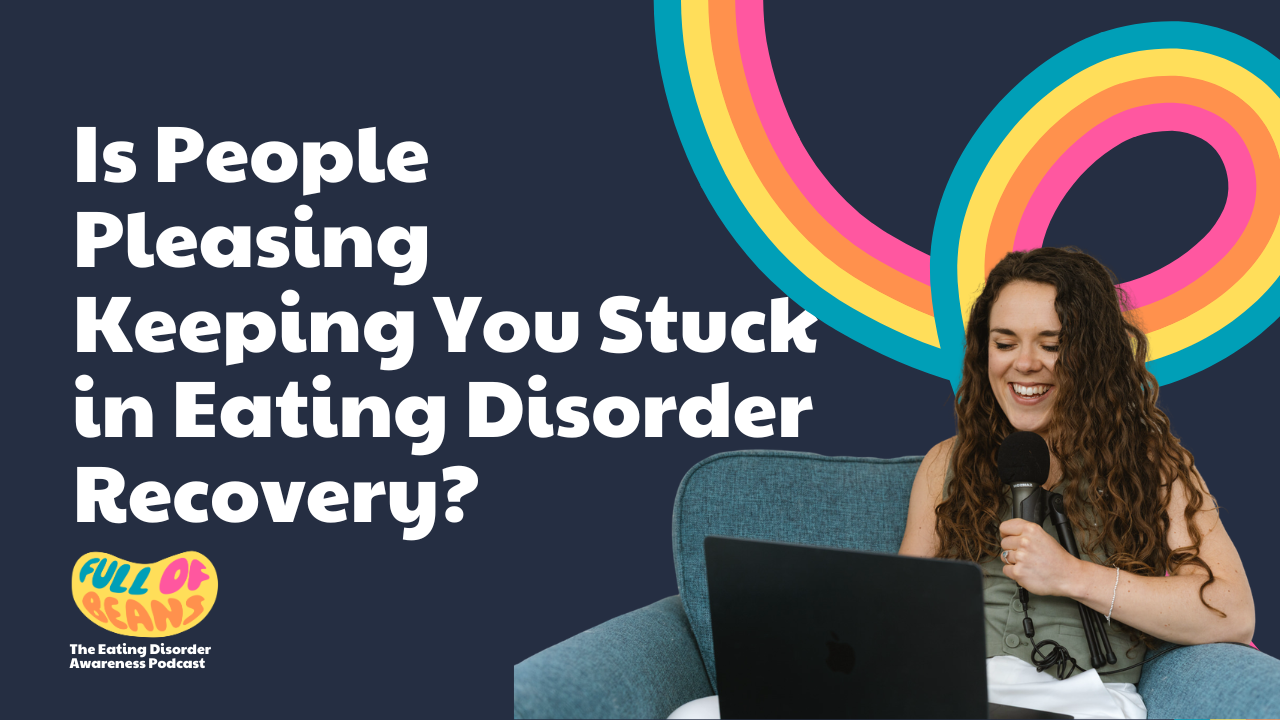
If you have ever sat in a therapy appointment and said all the right things, done all the right things, and still felt completely disconnected from your own recovery, this one is for you.
Because one of the most overlooked barriers to eating disorder recovery isn't a lack of wanting to get better. It's people pleasing. And this week on the Full of Beans Podcast, psychotherapist Sarah Parker, who has her own lived experience of anorexia, helped me understand why in a way, I don't think I've ever heard articulated quite so clearly before.
How People Pleasing Gets in the Way of Eating Disorder Recovery
For so many people with eating disorders, people pleasing isn't something that developed alongside the illness. It came first. It was a way of feeling safe in the world, of managing fear, avoiding rejection, and keeping the peace.
By the time it follows someone into a treatment setting, it is deeply ingrained. And the problem is that treatment can accidentally celebrate it. Compliance gets praised. Progress gets noted. And nobody stops to ask what is actually driving it.
Sarah describes this so honestly in our conversation. She did what she was told. She was seen as a model patient. And all of that compliance was rewarded, without anyone asking whether it was coming from a genuine place of wanting to recover, or from the same fear of rejection that had shaped her whole life.
When you are people pleasing your way through recovery, you aren't building new skills. You are using the same coping mechanism that has always kept you feeling safe. And when you go home and things get hard again, there is nothing new to reach for.
Trying to Please Everyone
What makes people pleasing in eating disorder recovery so complicated is the impossible position it can create. You are trying to balance the needs of your eating disorder, your treatment team, your family, and somewhere in the middle of all of that, you completely lose sight of yourself.
Sarah describes choosing one fear over another, not because she didn't want to recover, but because the fear of rejection from the people treating her felt more overwhelming than anything else. That is not a failure. That is a person doing the only thing they know how to do to feel safe.
And until someone created a space where she felt safe enough to stop performing and start being honest about what she actually needed, nothing could really change.
Why Motivation Wavers and Why That's Okay
One of the most important things Sarah discusses in this episode is the difference between motivation and commitment in eating disorder recovery, and why she believes commitment is the more powerful of the two.
Motivation is a feeling. And feelings are transient. You can leave a therapy appointment feeling genuinely fired up, only to find that a few hours later, everything feels impossible again. That is not a sign that you don't want to recover. That is just how minds work, particularly minds that have been through so much.
The trouble with placing too much weight on motivation is that when it wavers, and it will, because it always does, it can feel like evidence that recovery isn't possible. That you don't want it enough. That you have failed before you have really started.
None of that is true.
Finding Commitment in Eating Disorder Recovery
Commitment is different from motivation because it is an action rather than a feeling. And actions can be taken even on the days when every thought in your head is telling you not to.
Sarah describes waking up every morning during her recovery and returning to a simple mantra that she was committed to doing the best she could that day, regardless of how she felt. Not motivated. Committed. And that distinction, she says, made all the difference.
Because on the hard days, the days where motivation is nowhere to be found, where everything feels too much, where part of you wants to retreat into what feels familiar and safe, commitment is what carries you through. And those are often the days that matter most.
Recovery is not a straight line. It is a series of small, quiet acts of courage repeated over and over again. Some days, those acts feel manageable. Some days they feel enormous. But each one counts, regardless of how it felt to do it.
Finding Your Voice Alongside Finding Commitment
Something Sarah says that has stayed with me is that real recovery only began when she started finding her voice. Not the compliant, people-pleasing voice. The bold one. The one that could push back, get angry, take up space.
Because you cannot build a life around commitment to yourself if you are still spending all of your energy managing everyone else's feelings. At some point, gently, carefully, in whatever way feels safe, recovery asks you to come back to yourself.
And that, more than any single moment of motivation, is where things start to shift.
Please note that eating disorder recovery is deeply individual and looks different for everyone.
If anything in this blog resonates with you, please do explore it as part of your own journey and alongside your treatment team or support network. Support is available — in the UK, Beat can be reached at beateatingdisorders.org.uk 💛
🎧 Listen to the full conversation with Sarah Parker on the Full of Beans Podcast wherever you get your podcasts, or watch on YouTube.
Recent Posts