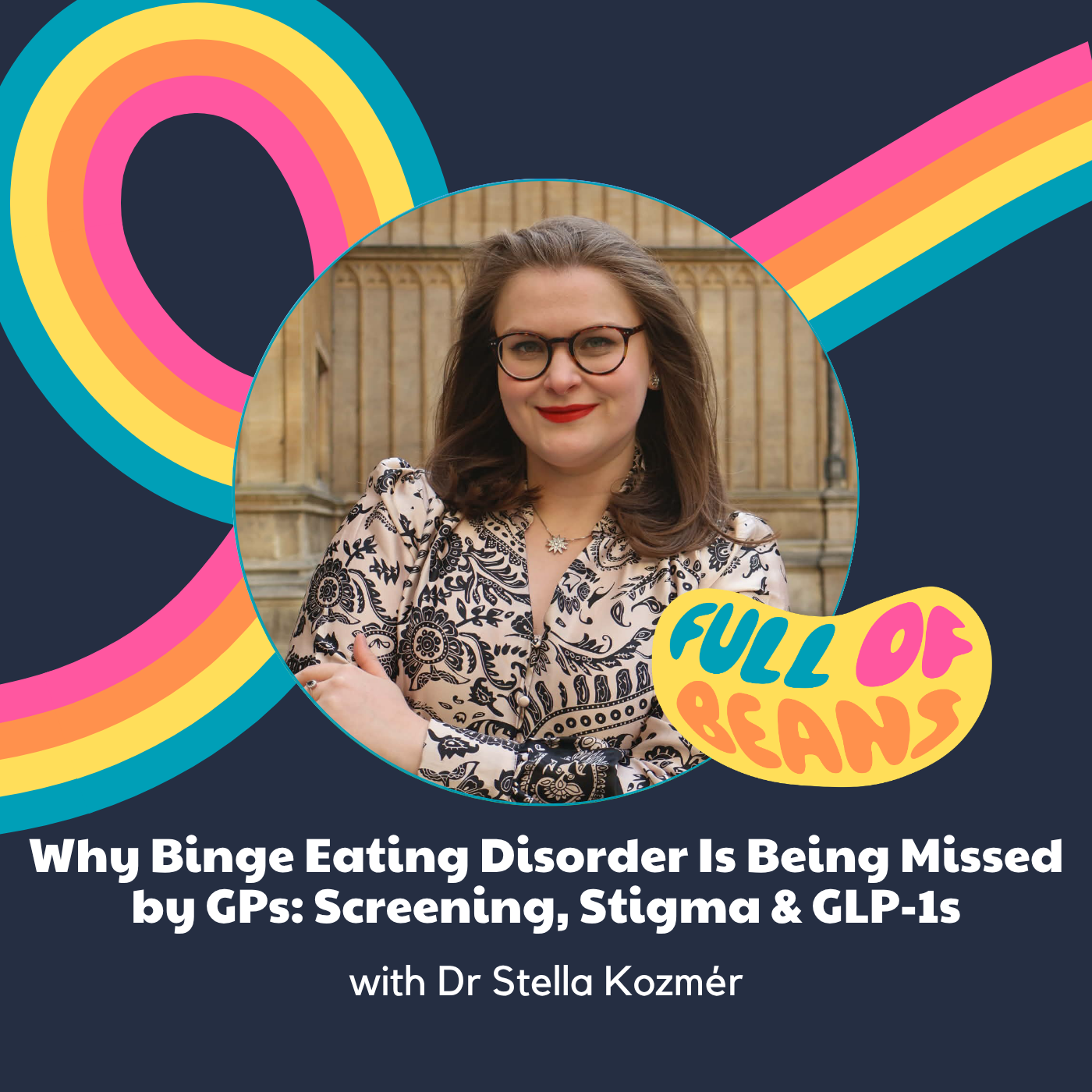
Why Binge Eating Disorder Is Still Missed by GPs: Screening, Stigma & GLP-1s
Why are we not recognising BED and BN?
If you've ever wondered why binge eating disorder (BED) and bulimia nervosa (BN) barely get talked about compared to other eating disorders, you're not imagining things. They're the most common eating disorders out there, and they're still slipping through the net in GP surgeries up and down the country.
This week I sat down with Dr Stella Kozmér, a researcher whose entire career has been shaped by a very personal realisation: after a decade of struggling, she found out what she'd been living with actually had a name. That moment changed the course of her research, and honestly, it changed this conversation too.
The screening tools weren't built for this
One of the things that properly stopped me in my tracks was learning just how few studies exist looking at how BED and BN show up, or fail to show up, in primary care. We're talking a handful, globally. Most of what we know comes from secondary care and psychiatric settings, because historically, that's where the research (and the funding) has always gone.
Stella's work looks closely at tools like SCOFF, the go-to screening questionnaire many GPs rely on. The problem? It was built before binge eating disorder was even formally recognised as its own diagnosis. So it catches some of what bulimia looks like, but it wasn't designed with BED in mind at all. Thirteen years on from BED's official recognition, we're still leaning on a tool that was never built to find it.
Weight stigma is doing a lot of quiet damage
Here's where it gets uncomfortable, and where Stella didn't hold back. A huge part of why BED goes unnoticed comes down to assumptions about bodies. If a GP believes obesity is simply about willpower, there's a real risk that a patient's binge eating gets read as a lifestyle issue rather than a mental health condition needing treatment.
And on the flip side, patients themselves can struggle to know what counts as "normal" eating when they're in a larger body, in a culture that's constantly sending mixed messages about weight, food and control. It's a genuinely difficult knot to untangle, and Stella has a lot to say about who should be involved in designing better screening tools going forward.
Why GPs aren't the villain here
Something Stella was really clear about: most GPs want to help. Many told her, in her research, that they'd refer patients in a heartbeat if they knew there was somewhere to refer them to. The issue isn't willingness. It's that nearly half of eating disorder services in the UK don't even see binge eating disorder patients. So what happens when a GP opens that conversation and has nowhere to send someone?
We talk through what that impossible position looks like for clinicians, and why the answer isn't simply "more training" if the services on the other end of a referral still don't exist.
So what actually needs to change?
This is the part of the conversation I found genuinely hopeful, because Stella isn't just pointing at the problem, she's pointing at a blueprint. There's a whole framework already working well for another chronic condition that the eating disorder field could learn a huge amount from, without needing a single extra penny of funding to start applying it. We get into exactly what that looks like, and why patient education has to be part of the answer.
A word on GLP-1 medications
You've probably seen GLP-1 medications everywhere in the news lately, and it was only a matter of time before the conversation turned to what they might mean for binge eating disorder. Stella's own research review looked closely at the evidence here, and her answer isn't a simple yes or no. There's real nuance in what the data shows so far, what it doesn't show, and why the framing of "weight loss" might be exactly the wrong way to think about it if these medications do have a role to play. It's one of the more thoughtful, least sensationalised takes on GLP-1s I've heard, and I don't want to boil it down to a soundbite here.
🎧 Listen to the full episode with Dr Stella Kozmér on the Full of Beans podcast, or watch on YouTube.
Recent Posts