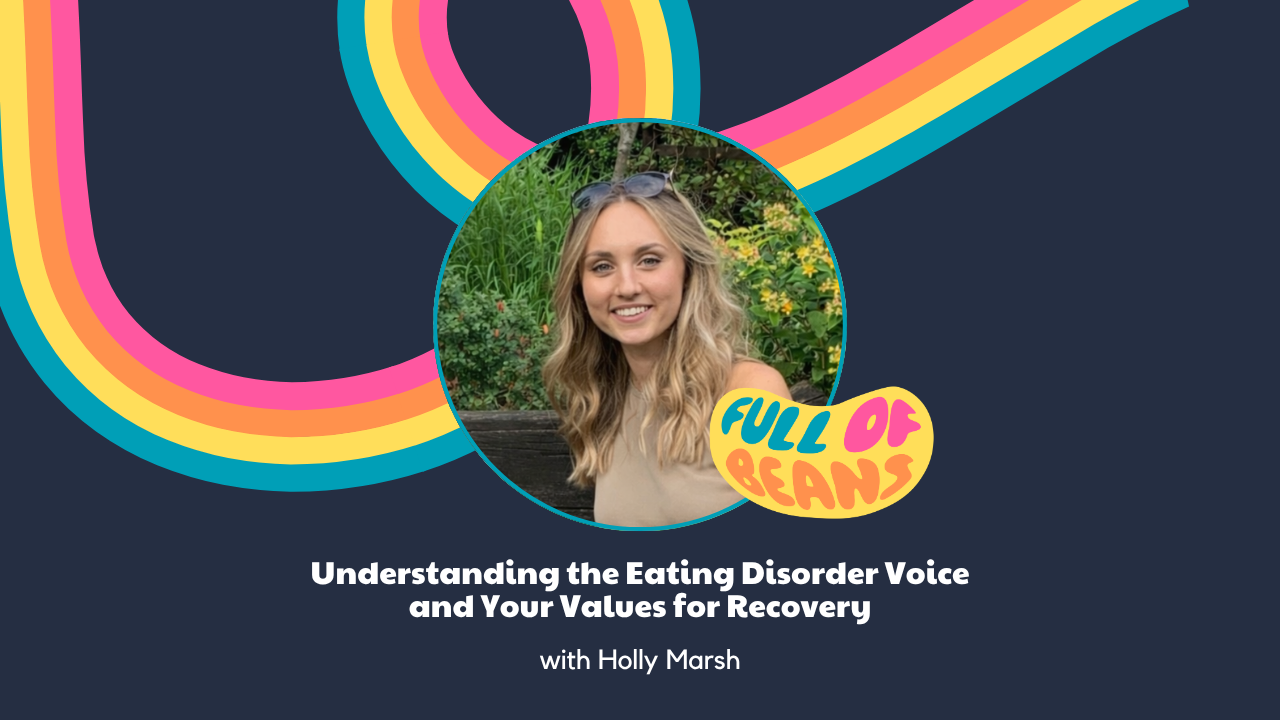
Understanding the Eating Disorder Voice and Your Values for Recovery with Holly Marsh
What is the eating disorder voice, and how do you know it’s not you?
If you’ve ever struggled with an eating disorder, you might have heard people talk about the “eating disorder voice.”
But what does that actually mean?
For many people, it doesn’t feel like a separate voice at all. It just feels like your thoughts, your logic and your truth.
And that’s exactly what makes it so powerful, and so difficult to challenge in recovery.
In this week’s Full of Beans podcast episode, I spoke to psychotherapeutic counsellor Holly Marsh, who specialises in eating disorders and brings her own lived experience into her work. Together, we explored what the eating disorder voice really is, how it shows up, and how you can begin to separate it from yourself in recovery.
What is the eating disorder voice?
The eating disorder voice isn’t always obvious, as it doesn’t necessarily sound like something external or separate; it often sounds like you. However, Holly explained in this week's episode that the voice has patterns, and is often:
- Rule-based (“you should…” / “you must…”)
- Rigid and absolute
- Future-focused (“if you don’t do this, something bad will happen”)
- Urgent and demanding
- It can also shape-shift, meaning sometimes it’s critical and cruel, yet other times it feels motivating or even rewarding
And sometimes, it can even feel like a superpower.
Why an eating disorder can feel like a “superpower”
This is one of the most important and least talked about parts of eating disorders. There can be moments where the eating disorder feels like control, discipline, something you’re good at and something that sets you apart. And that’s really hard to admit.
But it matters, because if we only talk about how painful eating disorders are, we miss the reason people stay stuck in them.
As Holly shared, if it all felt bad, we wouldn’t keep doing it.
There’s often a short-term payoff, a fleeting sense of achievement, safety, or superiority—that keeps the cycle going.
Why recovery can feel worse before it feels better
One of the most confusing parts of recovery is this: at first, it can feel worse, not better. When you begin stepping away from eating disorder behaviours:
- The numbness fades
- The “high” or sense of control disappears
- Hunger, exhaustion, and emotions return
And you haven’t yet experienced the benefits of recovery.
It can feel like being stuck in the middle, between what you know (the eating disorder) and what you hope is possible (recovery). Holly described this as standing in a dark tunnel, knowing there’s light somewhere… but not knowing which direction to go.
So, how do you start separating your thoughts?
If the eating disorder voice sounds like you… How do you tell the difference?
One of the most helpful shifts is this: instead of focusing on what the thought says, focus on where it leads you.
Ask yourself:
- If I follow this thought, where does it take me?
- Does it move me towards my values—or back into the eating disorder?
Because even if the thought sounds reasonable, the direction matters.
The role of values in eating disorder recovery
One of the most powerful anchors in recovery is values. Because when everything feels uncertain, values give you something to hold onto. For Holly, it was the desire to have children. For me, it was wanting to show up as a good friend, partner, and daughter.
Your values might be:
- Connection
- Freedom
- Honesty
- Creativity
- Family
- Purpose
Recovery isn’t just about moving away from the eating disorder. It’s about moving towards a life that feels meaningful.
Honesty, identity, and the reality of recovery
There’s a thread that runs through all of this: honesty.
Eating disorders thrive in secrecy, avoidance, and self-deception
Recovery asks for very different things, including self-awareness, openness and a willingness to question your thoughts. And sometimes that honesty is uncomfortable.
It might look like admitting:
- “This still feels appealing”
- “Part of me doesn’t want to let go”
- “I’m not being fully truthful here”
But those moments of honesty are often the ones that move you forward.
Final thoughts
The eating disorder voice can be loud, convincing, and deeply ingrained. But it’s not all of who you are.
There is another part of you, a quieter, more compassionate, more flexible part, that wants something different.
Recovery isn’t about getting rid of thoughts completely. It’s about learning to notice them, question them, and choose differently. And that takes time, practice, and support... But it is possible 💛
Recent Posts