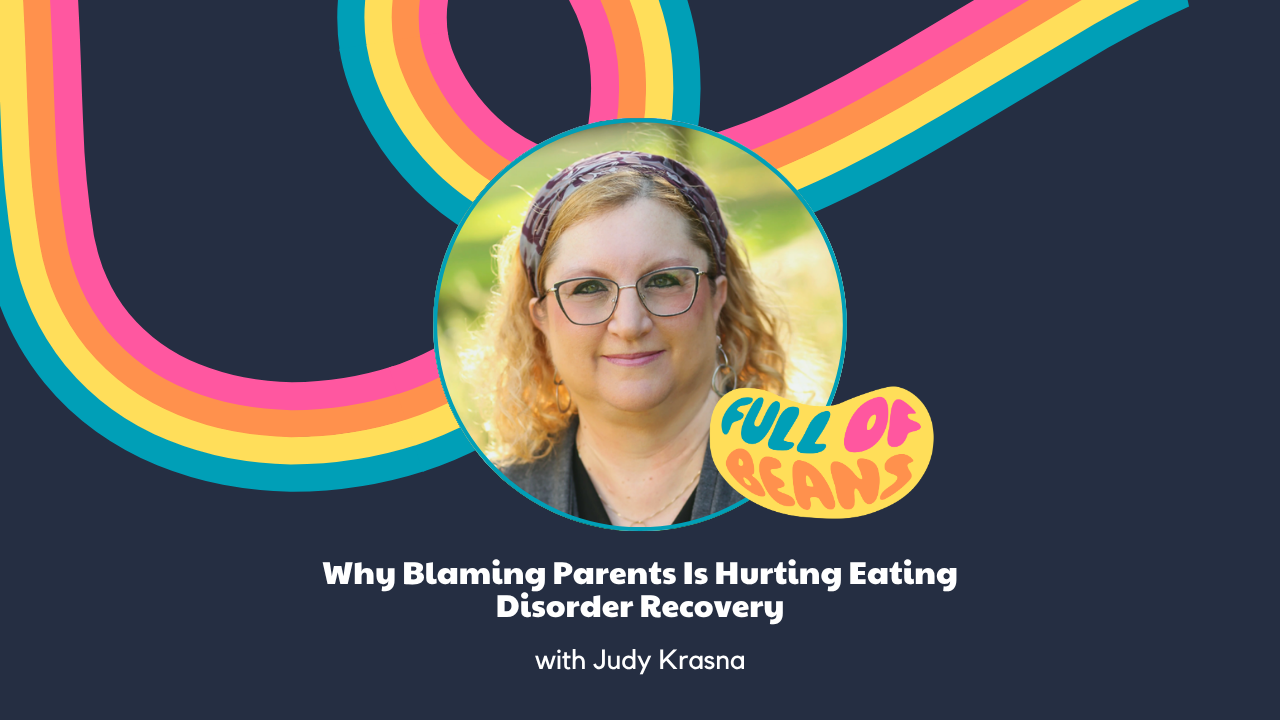
Why Blaming Parents Is Hurting Eating Disorder Recovery with Judy Krasna
Families aren't the enemy in recovery, they're the answer
When someone develops an eating disorder, it can feel like their loved ones worlds are turned upside down. Suddenly, everyone is in unfamiliar territory, feeling frightened, confused, and desperate to help. And yet, so often, the very people who love their child the most are the ones who are pushed furthest away from their care... but this needs to change.
In a recent conversation on the Full of Beans podcast, Judy Krasna, Executive Director of F.E.A.S.T. (Families Empowered and Supporting Treatment for Eating Disorders) and a mother who lost her daughter Gavriella to anorexia nervosa and suicide in 2020, shared her story of just what can happen when families are excluded from treatment.
Her words are ones that every parent, carer, loved one, and professional in this space needs to hear.
You Didn't Cause the Eating Disorder
One of the most common experiences for any parent of a child with an eating disorder is guilt. The endless loop of "Was it something I said? Something I did? Something I didn't do?" plays on repeat, stealing energy and focus at the exact moment it's needed most.
Judy is certain on this for sure: eating disorders are not caused by parents.
In our podcast together, she shared:
"I couldn't even cause an eating disorder if I tried. There are genetic components, there are biological components, there are components which are not at all environmental. If the genetics aren't there, and if the predisposition isn't there, and if the biology isn't there, there's no eating disorder."
Understanding the science isn't about letting anyone off the hook. It's about freeing families up to do what they do best, to love and support their child. Because when parents are stuck in a cycle of blame and self-doubt, they cannot be mobilised to help. And that loss of mobilisation has real, lasting consequences.
What Happens When Parents Are Pushed Out
Judy speaks from deeply personal experience about what it feels like to be blamed by your child's treatment team... not subtly, but openly. And the damage that blame caused rippled far beyond her and her husband. It extended to her other children, who refused therapy for years afterwards because they believed that's what therapy meant: being told it was their fault.
She shared:
"If you consider parents part of the problem, you can't consider them part of the solution. We were totally not utilised because they were so busy keeping us at arm's length."
This is the key part... when families are excluded, the person with the eating disorder loses their most invested supporters. No one, not a therapist, not a treatment team, not a support worker, will ever be as committed to a child's recovery as their parent. That is not a resource to be sidelined - it is one of the most powerful tools available.
Connection is Key
Eating disorders are isolating by nature, for the person suffering, and for the family around them. Judy describes the way friends drifted away during her daughter's illness, how exhausting it became to explain, and how easy it was to simply withdraw. It is a loneliness that is often invisible, because all eyes are, understandably, on the person who is unwell.
But that isolation matters. And connection, Judy says, is one of the most vital things a parent can offer, even when it feels like it isn't working.
"Always let your child know that you're there for them. Even when the eating disorder is raging against you, especially when the eating disorder is raging against you, you have to keep saying, I love you. Because even though it doesn't feel like the message is getting through, I've heard from plenty of people who have recovered that it did."
Recovery is rarely one single moment. It's a slow, painstaking process built on many things, good treatment, time, coping skills, and support. And the support, as Judy notes, doesn't have to be a parent. It can be a partner, a sibling, a chosen family. But somebody needs to be there, holding the hope when the person with the eating disorder cannot hold it for themselves.
What Parents Can Do To Help
If you are a parent who is exhausted, frightened, and wondering whether any of it is making a difference, it is. Even on the days when it doesn't feel like it.
Stay connected. Keep showing up. Learn everything you can about eating disorders, because knowledge truly is power. And please, do not carry this alone.
F.E.A.S.T. exists for exactly this reason: to make sure that no family has to navigate this journey without support, information, and a community that truly understands. With over 17,000 families across more than 100 countries, it is proof that you are not alone in this, even when it feels that way.
As Judy says:
"Never, ever give up hope. Recovery is always a possibility, no matter how sick someone is."
And neither, for that matter, should you ever give up on yourself.
To find out more about F.E.A.S.T. and access their free resources, visit www.feast-ed.org
This blog was written in conversation with Judy Krasna, who appeared on the Full of Beans podcast. You can listen to the full episode [here]
Recent Posts