When the System Wasn't Built for You: Trans Identity, AuDHD and Eating Disorders with Eva Echo
Eva Echo on Fighting to Be Seen, Heard and Believed
If you have ever walked into a healthcare setting and felt like the real you was completely invisible, like one part of your identity was being used to explain away everything else, this one is for you.
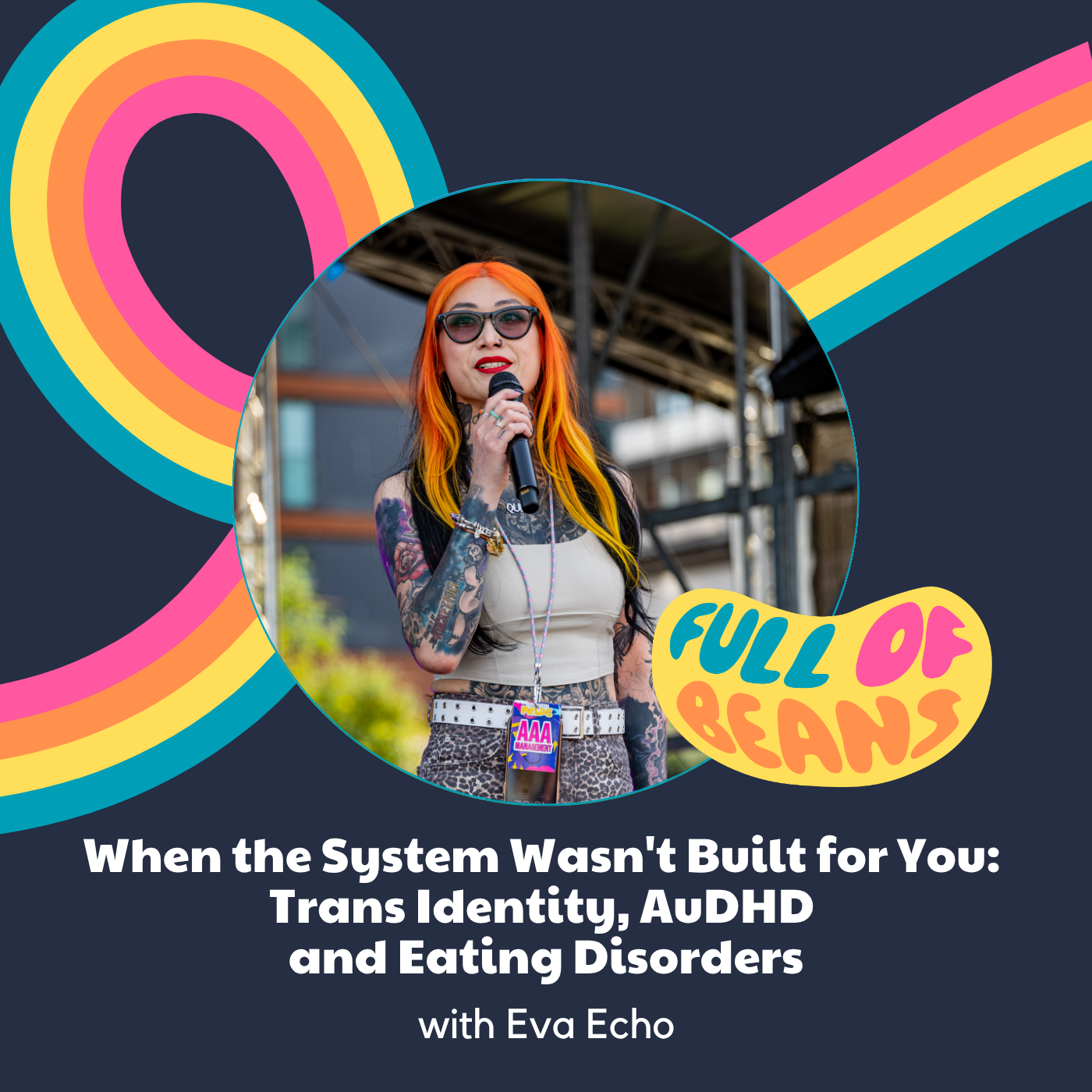
This week on the Full of Beans Podcast, I sat down with Eva Echo, activist, writer, TEDx speaker, and someone with lived experience of an eating disorder and AuDHD, to explore how our identity can both impact our experiences and be used against us.
Eva has spent years fighting for trans plus people in UK healthcare, including taking NHS England to the High Court over trans NHS waiting times. But what struck me most was how personal her story is, and how many people will hear themselves in it.
The Intersection of Trans Identity, AuDHD and Eating Disorders
Eva has lived with restrictive eating since her teens, though she didn't have the language for it straight away. When she reflects on how it developed, she is clear that it wasn't one thing. It was a perfect storm of not feeling in control, going through puberty in a body that didn't feel like hers, being bullied, having a difficult relationship with her biological family, and not yet having the words to understand that she was trans.
Restrictive eating gave her control over her body at a time when everything else felt entirely out of her hands. And that makes complete sense, even if it came at a significant cost.
Since then, Eva has also been diagnosed with autism and ADHD, and the more she has learned about herself, the more she has understood how deeply those pieces intersect with her eating disorder. Things like alexithymia, not having that internal connection to feelings, including hunger, mean that the eating disorder can hide in plain sight. As Eva puts it, she can go a whole day without feeling hungry or thirsty.
That disconnection isn't a choice. It is part of how her nervous system works. For anyone navigating eating disorders and autism together, or eating disorders and ADHD, this will likely resonate deeply.
Medical Gatekeeping and Eating Disorders
One of the things Eva shares in this episode that has really stayed with me is the first time she went to a GP and said she thought she had an eating disorder. She was in her mid to late twenties, had not yet come out, and was presenting in a masculine way. The GP told her that males tend not to get eating disorders, put it down to depression, prescribed antidepressants, and sent her on her way.
And Eva, understandably, took that as confirmation. A doctor had told her she couldn't have an eating disorder. So she didn't push it. And that allowed the eating disorder to dig deeper for years.
This is medical gatekeeping in one of its most damaging forms. Not a dramatic refusal. Just a quiet, confident dismissal from someone in a position of authority, at a moment when Eva was already vulnerable enough to ask for help. It is a pattern that far too many people recognise, and one that urgently needs to change.
Trans Broken Arm Syndrome
Eva introduces a term in this episode that I think everyone should know: trans broken arm syndrome. It describes the experience of a trans person going to a healthcare setting with any concern, and having their transness become the focus of every question, every assumption, every explanation, regardless of what they actually came in for.
For Eva, this has meant her gender identity being used to explain away her eating disorder, her neurodivergence, her mental health. Rather than being seen as a whole person with multiple things going on, she has repeatedly been reduced to one label, and everything else has been filed underneath it.
The harm of this is not just practical, though the practical harm is real. It is the message it sends to a person who is already fighting to be seen. That their experience isn't credible. That they don't deserve to have each part of them taken seriously. For trans people with eating disorders, this kind of dismissal can be genuinely dangerous.
Taking NHS England to the High Court
Eva is one of a small number of people who took NHS England to the High Court over unlawful waiting times for trans plus patients. She has been waiting nine years for her first appointment at a gender clinic. Nine years. And she is not alone in that.
The case was ultimately unsuccessful in challenging the NHS trans waiting times directly, but it achieved something landmark. The court ruled that under 18s who are trans or non-binary are covered under the Equality Act, meaning they have legal protection against discrimination on the grounds of gender reassignment. For a community that faces discrimination at every turn, including within the very services designed to support them, that matters enormously.
Why Treatment Can Feel Like a Conveyor Belt
Something Eva says that I keep coming back to is the image of the NHS as a conveyor belt. You get on, you are moved through a set number of sessions, and then you are expected to be off the other end. But for someone navigating an eating disorder that has been present for decades, alongside autism, ADHD, and a trans identity that the system has consistently failed to hold, a set number of weeks on a programme is never going to be enough.
What gets lost on the conveyor belt is the person. Their history, their complexity, the parts of their identity that don't fit neatly into a diagnosis code. And without those parts, you are not treating a whole person. You are treating a set of symptoms. This is something we hear time and again on the Full of Beans Podcast, and Eva's experience brings it into very sharp focus.
The Path: Eva's Analogy for Eating Disorder Recovery
One of the most beautiful things Eva shares in this episode is what she calls the path analogy. She describes an eating disorder like a path through a field, one that becomes more defined the more you walk it, until eventually you know it is there even when you are not on it.
Now that she knows that path exists, she cannot unknow it. But she can choose not to walk down it. And there is something quietly powerful in that, the idea that eating disorder recovery is not about pretending the path was never there, but about building enough of a life elsewhere that you don't need to go down it anymore. For anyone in recovery who has wondered whether the thoughts ever truly leave, this analogy might offer a different and more compassionate way of thinking about it.
Be Your Own Kind of Beautiful
Eva's message at the end of this episode is simple, and I think it is everything. Be your own kind of beautiful. You deserve to be heard. You deserve to have every part of you taken seriously. And if someone closes a door, ask for a second opinion, because you are worth fighting for.
If you are trans, neurodivergent, or both, and you are navigating an eating disorder in a system that wasn't built for you, I hope this conversation helps you feel a little less alone. And if you are a clinician or someone working in healthcare, I hope it opens something up.
🎧 Listen to the full conversation with Eva Echo on the
Full of Beans Podcast wherever you get your podcasts, or watch on YouTube.
Recent Posts